 f9faa33686
Break up the config module into one submodule per configuration option. This commit also changes the default configuration with the new options system to be varint (the old system still uses fixint to preserve backwards compatibility). |
||
|---|---|---|
| .github/workflows | ||
| examples | ||
| src | ||
| tests | ||
| .gitignore | ||
| Cargo.toml | ||
| LICENSE.md | ||
| README.md | ||
| logo.png | ||

README.md
Bincode
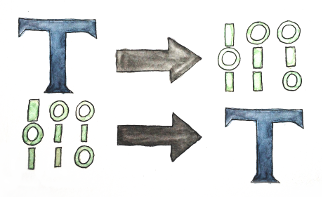


A compact encoder / decoder pair that uses a binary zero-fluff encoding scheme. The size of the encoded object will be the same or smaller than the size that the object takes up in memory in a running Rust program.
In addition to exposing two simple functions
(one that encodes to Vec<u8>, and one that decodes from &[u8]),
binary-encode exposes a Reader/Writer API that makes it work
perfectly with other stream-based APIs such as Rust files, network streams,
and the flate2-rs compression
library.
API Documentation
Bincode in the wild
- google/tarpc: Bincode is used to serialize and deserialize networked RPC messages.
- servo/webrender: Bincode records webrender API calls for record/replay-style graphics debugging.
- servo/ipc-channel: IPC-Channel uses Bincode to send structs between processes using a channel-like API.
Example
use serde::{Serialize, Deserialize};

#[derive(Serialize, Deserialize, PartialEq, Debug)]
struct Entity {
    x: f32,
    y: f32,
}

#[derive(Serialize, Deserialize, PartialEq, Debug)]
struct World(Vec<Entity>);

fn main() {
    let world = World(vec![Entity { x: 0.0, y: 4.0 }, Entity { x: 10.0, y: 20.5 }]);

    let encoded: Vec<u8> = bincode::serialize(&world).unwrap();

    // 8 bytes for the length of the vector, 4 bytes per float.
    assert_eq!(encoded.len(), 8 + 4 * 4);

    let decoded: World = bincode::deserialize(&encoded[..]).unwrap();

    assert_eq!(world, decoded);
}
Details
The encoding (and thus decoding) proceeds unsurprisingly -- primitive
types are encoded according to the underlying Writer, tuples and
structs are encoded by encoding their fields one-by-one, and enums are
encoded by first writing out the tag representing the variant and
then the contents.
However, there are some implementation details to be aware of:
isize/usizeare encoded asi64/u64, for portability.- enums variants are encoded as a
u32instead of ausize.u32is enough for all practical uses. stris encoded as(u64, &[u8]), where theu64is the number of bytes contained in the encoded string.