 f4c5c7b86d
|
||
|---|---|---|
| examples | ||
| src | ||
| tests | ||
| .gitignore | ||
| .travis.yml | ||
| Cargo.toml | ||
| LICENSE.md | ||
| README.md | ||
| logo.png | ||
| readme.dev.md | ||

README.md
Bincode
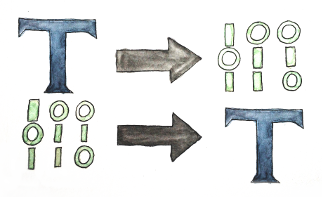


A compact encoder / decoder pair that uses an binary zero-fluff encoding scheme. The size of the encoded object will be the same or smaller than the size that the object takes up in memory in a running Rust program.
In addition to exposing two simple functions that encode to Vec and decode from Vec, binary-encode exposes a Reader/Writer API that makes it work perfectly with other stream-based apis such as rust files, network streams, and the flate2-rs compression library.
Example
extern crate bincode;
extern crate rustc_serialize;

use bincode::SizeLimit;
use bincode::rustc_serialize::{encode, decode};

#[derive(RustcEncodable, RustcDecodable, PartialEq)]
struct Entity {
    x: f32,
    y: f32,
}

#[derive(RustcEncodable, RustcDecodable, PartialEq)]
struct World {
    entities: Vec<Entity>
}

fn main() {
    let world = World {
        entities: vec![Entity {x: 0.0, y: 4.0}, Entity {x: 10.0, y: 20.5}]
    };

    let encoded: Vec<u8> = encode(&world, SizeLimit::Infinite).unwrap();

    // 8 bytes for the length of the vector, 4 bytes per float.
    assert_eq!(encoded.len(), 8 + 4 * 4);

    let decoded: World = decode(&encoded[..]).unwrap();

    assert!(world == decoded);
}
Details
The encoding (and thus decoding) proceeds unsurprisingly -- primitive
types are encoded according to the underlying Writer, tuples and
structs are encoded by encoding their fields one-by-one, and enums are
encoded by first writing out the tag representing the variant and
then the contents.
However, there are some implementation details to be aware of:
isize/usizeare encoded asi64/u64, for portability.- enums variants are encoded as a
u32instead of auint.u32is enough for all practical uses. stris encoded as(u64, &[u8]), where theu64is the number of bytes contained in the encoded string.